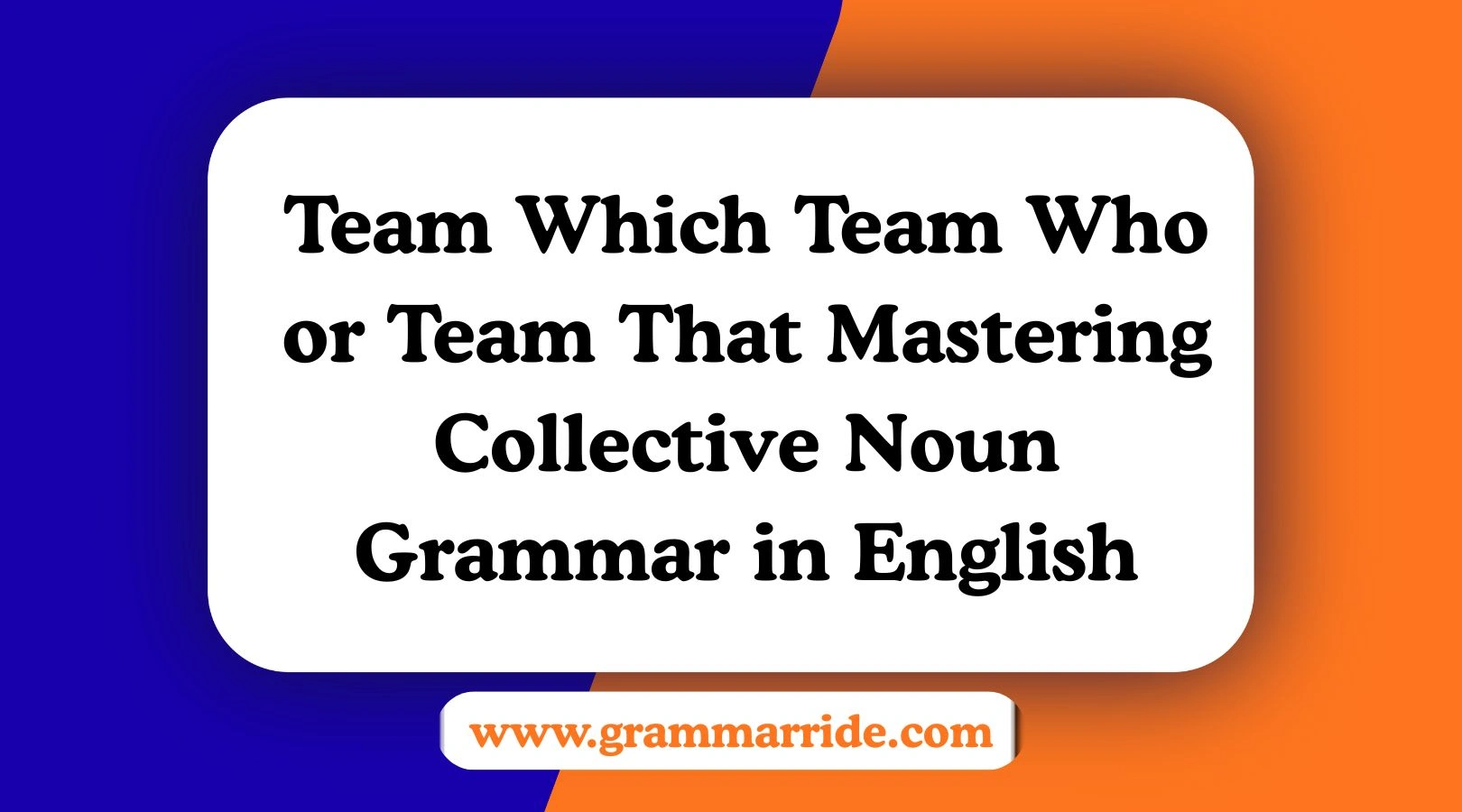
When I first began writing professionally, even as an experienced editor, I often paused to decide whether to use team which, team who, or team that, a choice that impacts tone, flow, and clarity in formal contexts. It may sound simple, but the grammar behind it is tricky, like a puzzle with rules constantly shifting, and mastering pronouns for a collective noun requires spotting subtle nuances in usage.
In daily practice, skilled writers and speakers struggle with this, especially when referring to people in a team who won a championship. Using who can feel personal and humanizing, a phrasing that fits natural, often British, settings, while a neutral, technical, or American approach may prefer that, treating the team as one entity.
These subtle distinctions matter because the wrong choice can turn a crafted message into a grammatical nightmare, preventing it from coming across clearly, a skill I’ve practiced and refined over the year.
Understanding Collective Nouns
Collective nouns are words that describe a group of people, animals, or things as a single entity. Examples include team, committee, jury, family, and audience. What makes collective nouns tricky is that English can treat them in two ways:
- As a single unit (singular): The team is ready to play.
- As individual members (plural): The team are arguing among themselves.
The choice affects both the verb you use and the relative pronouns that follow. Misusing them can make your writing sound awkward or confusing.
Table: Common Collective Nouns and Typical Usage
| Collective Noun | Common Context | US English Verb | UK English Verb |
| Team | Sports, Work | Singular | Singular/Plural |
| Committee | Work, Government | Singular | Plural |
| Jury | Legal | Singular | Plural |
| Audience | Event, Theater | Singular | Singular/Plural |
| Family | Personal | Singular | Singular |
By understanding these nouns, you’ll grasp when to use singular or plural forms naturally.
The Grammar Conundrum: Which, Who, or That?
Relative pronouns link a clause to a noun or pronoun. Choosing the right one depends on what you’re referring to:
- Who → Refers to people.
Correct: “The team who trained the hardest won the championship.”
Incorrect: “The team who is a software company launched a new app.” - Which → Refers to objects or groups, often in formal contexts.
Correct: “The team, which was founded in 1998, has won five championships.” - That → Versatile; can refer to people or groups in restrictive clauses.
Correct: “The team that scores the most points wins the trophy.”
Quick Tip: If the clause is essential to the meaning, use that. If it’s additional info, use which. Use who only when referring to people, even if they are part of a team.
Singular vs. Plural Verb Agreement
Here’s where most people get stuck. Collective nouns can be singular or plural, depending on regional norms and context.
American English
- Generally treats collective nouns as singular.
- Examples:
- “The team is preparing for the finals.”
- “The committee decides on the new policy.”
British English
- More flexible; often treats collective nouns as plural when referring to members acting individually.
- Examples:
- “The team are wearing their new jerseys.”
- “The jury have reached their verdict.”
Why It Matters
Incorrect agreement can confuse readers. Imagine reading:
- “The team are ready to play” (US audience might find this odd).
- “The team is arguing among themselves” (UK audience may expect “are”).
List: Quick Rules
- Use singular verbs when the team acts as a unit.
- Use plural verbs when members act individually or differently.
- Adjust based on whether your audience follows US or UK conventions.
Contextual Clues for Verb Agreement
Context often guides your choice. Ask yourself: is the team acting together or as individuals?
Sports Example
- Singular: “The Lakers is winning the championship.” → Treating the team as one entity (US style).
- Plural: “The Lakers are arguing about the strategy.” → Members are acting individually (UK style).
Business Example
- Singular: “The marketing team is finalizing the campaign.”
- Plural: “The marketing team are expressing different opinions about the campaign.”
Tip: Words like each member, every player, all members often signal plural verbs.
Collective Nouns in Sports
Sports are a prime context for collective noun confusion. Here’s what you need to know:
- Team names often sound plural, so writers default to plural verbs.
- Example: “The Yankees are dominating the league.”
- Sports commentary may vary based on audience:
- US commentary: singular focus → “The team is winning.”
- UK commentary: plural focus → “The team are winning.”
Table: Sports Team Grammar Usage
| Team Context | Example Sentence (US) | Example Sentence (UK) |
| Acting as a unit | “The Bulls is playing tonight.” | “The Bulls are playing tonight.” |
| Members acting separately | “The Bulls are arguing among themselves.” | Same as US |
This table shows why context, not just rules, determines correct grammar.
Collective Nouns in Business
In business, clarity is paramount. Misaligned verbs can confuse teams or misrepresent authority.
Singular Focus
- “The HR team is implementing the new policy.”
- Treats the team as one organized unit.
Plural Focus
- “The HR team are submitting their individual reports.”
- Highlights independent actions or disagreements within the team.
Business Writing Tips
- Emails & reports: Usually singular verbs for professionalism.
- Internal discussions: Plural verbs can show internal diversity of opinions.
Example Table: Business vs Sports Verb Choice
| Context | Team Verb | Usage Explanation |
| Business Email | singular | Clear, professional tone |
| Internal Memo | plural | Highlights individual actions/opinions |
| Sports Article | plural | Audience expects players acting individually |
| Sports Broadcast | singular | Emphasizes team as a single entity |
Exceptions and Special Cases
Some cases intentionally break the singular/plural rules for emphasis:
- Disunity in teams: “The team are divided on the proposal.”
- Multiple sub-teams: “The research team are working in three separate labs.”
- Emphasizing individuals: “Each member of the team is responsible for their task.”
Understanding these exceptions allows you to write precisely and naturally, avoiding awkward constructions.
Practical Rules of Thumb
Here’s a handy checklist for when you’re unsure about team grammar:
- Who → people (members of a team).
- Which → groups or things (formal, additional info).
- That → restrictive clauses (essential info).
- Singular verb → team acting as one entity.
- Plural verb → team members acting individually.
- Pay attention to modifiers like each, every, all members.
- Adjust based on your audience region (US vs UK).
Mini Quiz Example
Choose the correct sentence:
- The committee (is/are) voting on the new policy.
- The team (who/that) scores first wins the trophy.
Answers: 1 → is (US), 2 → that.
Conclusion
Understanding the correct use of team which, team who, or team that is key for clear and professional writing. Choosing the right pronoun depends on whether you are focusing on the group as a single entity or the individuals who make it up. Using who can feel personal and humanizing, while that often works in neutral or technical contexts.
Paying attention to these subtle nuances impacts the tone, flow, and clarity of your sentence, preventing grammatical nightmares and ensuring your crafted message comes across clearly.
FAQs
Q1: When should I use “team who”?
A1: Use team who when referring to the individuals in the group, especially in personal, humanizing, or British settings.
Q2: When should I use “team that”?
A2: Use team that in neutral, technical, or American contexts, treating the team as a single entity.
Q3: Does it matter which pronoun I choose?
A3: Yes, the choice impacts the tone, flow, and clarity of your sentence, and using the wrong pronoun can create a grammatical nightmare.
Q4: Can I mix “who” and “that” in the same document?
A4: It’s possible, but consistency is important. Focus on whether you’re emphasizing individuals (who) or the group as one (that).
Q5: How can I practice using these correctly?
A5: Through writing, editing, proofreading, and analyzing reviews to spot nuances in pronoun usage.
Additional Resources
- Merriam-Webster: Collective Nouns
- Oxford English Dictionary: Grammar Usage
- Cambridge Dictionary: Singular or Plural Collective Nouns

Grace Edwards is a dedicated grammar expert and language lover who helps readers sharpen their writing skills with clarity and confidence. With extensive experience in linguistics and digital content, she transforms complex grammar into simple, engaging lessons. Grace believes that powerful communication starts with precise language.